

When Every Second Counts: What Childcare Providers Need to Know About CPR Certification
CPR certification for childcare is a legal requirement in every U.S. state — and one of the most important skills any person working with young children can have.
Here’s a quick overview of what most providers need to know:
| Question | Quick Answer |
|---|---|
| Who needs it? | All staff in licensed childcare facilities such as daycares and preschools |
| What type? | Pediatric CPR First Aid (covering infants and children) |
| How long is it valid? | 2 years — must be kept current at all times |
| Can it be done fully online? | No — hands-on skills practice with a manikin is required |
| Which providers are accepted? | American Heart Association, American Red Cross, and EMSA-approved programs |
Unintentional injuries are the leading cause of death among children ages 1 to 4 in the United States. More than 7,000 children have out-of-hospital cardiac arrests each year – and survival chances improve when a trained bystander acts right away.
Childcare providers are often the first — and only — person on the scene when something goes wrong.
Whether you’re a daycare director building a compliant team, a family childcare home licensee renewing before your license inspection, or a preschool teacher getting certified for the first time, understanding exactly what’s required can feel overwhelming. Requirements vary by state, training formats aren’t all equal, and the wrong certification can mean a failed inspection.
This guide breaks it all down clearly.
Why Pediatric CPR First Aid Training is Essential for Childcare Providers
As childcare professionals, we hold the immense responsibility of keeping vulnerable young children safe while they learn, play, and grow. Children are not simply “miniature adults.” Their bodies are physically different, their airways are smaller, and the medical emergencies they face require highly specialized care.
When an infant stops breathing during a nap or a toddler chokes on a small toy, we cannot afford to hesitate. The American Heart Association reports that more than 7,000 children experience out-of-hospital cardiac arrest each year in the United States. In those terrifying moments, immediate CPR from a trained caregiver can double or even triple the chance of survival.
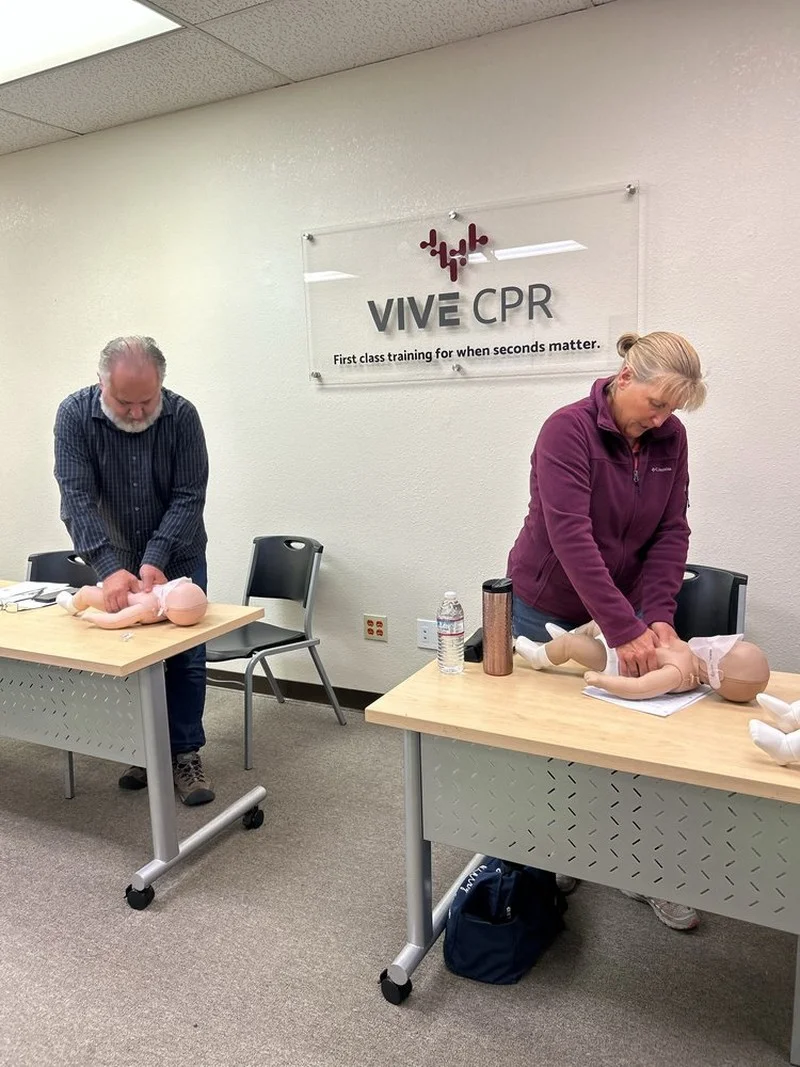
Beyond cardiac events, daycares and preschools are dynamic environments where accidents happen in the blink of an eye. From severe allergic reactions (anaphylaxis) and asthma attacks to deep cuts, burns, and sudden falls, having proper pediatric first aid skills allows us to react with calm, decisive action.
But obtaining your certification is about more than just keeping kids safe; it also builds a foundation of trust. When parents look for a daycare or preschool, they want absolute peace of mind. Displaying current, high-quality certification credentials shows families that your facility prioritizes safety above all else. It elevates your professional reputation and protects your business from devastating liability issues.
For parents who want to learn these life-saving skills without needing a professional credential for work, we also offer non-certification options like our Infant CPR for Parents class. However, for anyone working in a professional childcare capacity, formal certification is non-negotiable.
Requirements for CPR Certification for Childcare
Navigating childcare regulations can feel like solving a puzzle with shifting pieces. In California, childcare licensing follows Title 22 of the California Code of Regulations and the California EMSA childcare provider training requirements.
To make sense of what is required for your license, here is a breakdown of the training requirements for California childcare providers:
| Requirement Category | Details for California Childcare Providers |
|---|---|
| Total Initial Training Hours | 16 hours total (8 hours of Pediatric CPR & First Aid + 8 hours of Preventive Health & Safety Practices) |
| CPR/First Aid Split | 4 hours of Pediatric CPR/AED training and 4 hours of Pediatric First Aid |
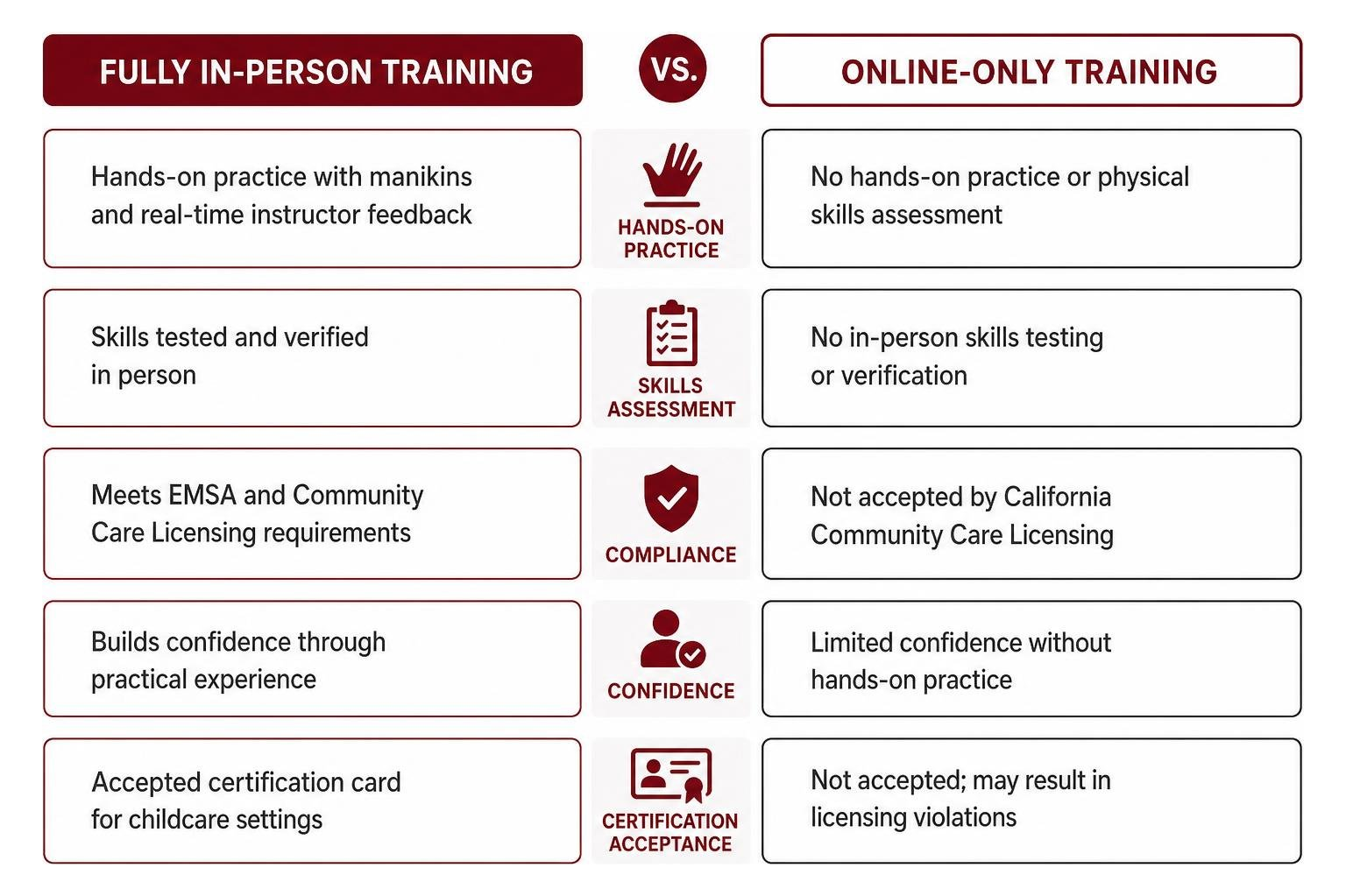
| Acceptable Formats | Fully in-person, instructor-led training is required for EMSA compliance. Online-only or hybrid/blended formats do not satisfy California licensing. |
| Approved Organizations | American Heart Association (AHA), American Red Cross (ARC), and EMSA-approved training programs are acceptable. |
| Renewal Cycle | Every 2 years for Pediatric CPR & First Aid. Preventive Health is a one-time requirement. |
| Regulatory Codes | California Health and Safety Code, California Code, HSC 1596.866 |
Under California Code, HSC 1596.866, all staff providing direct care in licensed childcare centers and family childcare homes must complete at least 15 hours of health and safety training (which is implemented as a 16-hour curriculum by approved training programs).
This 16-hour total is split evenly:
- 8 Hours of Pediatric CPR and First Aid: This covers life-saving physical interventions, choking relief, AED use, and emergency first aid.
- 8 Hours of Preventive Health and Safety Practices: This covers infectious diseases, immunizations, sanitary food handling, disaster planning, and childhood nutrition.
If you are ready to complete your CPR First Aid requirement for childcare, you can enroll directly in our EMSA-compliant American Heart Association Pediatric CPR First Aid Certification course.
Who Needs CPR Certification for Childcare?
If you are employed by or operating a licensed childcare facility in California, you must meet these training standards. This includes:
- Daycare Center Directors and Lead Teachers: At least one director or teacher with current pediatric CPR and first aid certification must be physically present on-site when children are in care.
- Daycare Center Staff and Assistants: Centers often require additional staff to stay certified so coverage continues during breaks, illnesses, field trips, or schedule changes.
- Family Childcare Home Licensees: Every person licensed to operate a family childcare home must complete the required pediatric CPR and first aid training.
- Substitutes and Adult Assistants: Substitutes or adult assistants who provide care in a licensed family childcare home must also be certified.
- Preschool Teachers, Nannies, and Babysitters: Preschool staff working in licensed programs need certification. Independent in-home caregivers, nannies, and babysitters who are not connected to a licensed childcare facility are generally not legally required to complete this training, though many families still prefer it for safety and peace of mind.
Compliance Timelines: New childcare employees must typically obtain their certifications within 90 days of their hire date. However, having your team certified before they begin supervising children is the safest best practice.
How to Verify Approved CPR Certification for Childcare Programs
One of the most common mistakes childcare providers make is taking a cheap, fast course online, only to have their licensing inspector reject the certificate during an audit.
To ensure your training is fully approved and accepted by Community Care Licensing inspectors:
- Look for Approved Providers: Your training must be provided by the American Heart Association (AHA), the American Red Cross, or an EMSA-approved training program. Because the AHA and Red Cross are recognized directly by name in California state law, their certification cards are accepted.
- Select the Correct Course: Make sure you enroll in a pediatric-focused course, such as the Heartsaver® Pediatric First Aid CPR AED Training | American Heart Association CPR & First Aid. Standard adult-only CPR cards will not satisfy childcare licensing requirements.
- Avoid Online-Only Pitfalls: If a program claims you can get certified quickly without ever touching a manikin, it will not be accepted by licensing inspectors. Even Blended Learning Pediatric CPR First Aid courses are not accepted. The course must be completed entirely in person.
In-Person vs. Online: Choosing the Right Training Format
With busy schedules, it is incredibly tempting to look for a quick online course. However, when it comes to CPR certification for childcare in California, the training format you choose makes all the difference between being compliant or facing a licensing violation.
The Myth of the 100% Online CPR Card
Let’s make this as clear as possible: online-only CPR certificates without an in-person, hands-on skills assessment are not accepted by California Community Care Licensing.
While you can find many websites offering “instant” online pediatric CPR certificates, these do not meet EMSA guidelines. Reading about CPR or watching a video is simply not the same as physically performing it. In an emergency, your brain relies on muscle memory. Knowing how hard to push, how fast to compress, and how to properly seal a pocket mask requires physical practice on a manikin.
Blended Learning Is Not Accepted for Childcare CPR
Blended Learning is a training format that combines an online course with an in-person Skills Session. Typically, students complete the knowledge portion online first, then meet with an instructor to practice CPR, AED use, and first aid skills on manikins. It can be a useful option for some workplace training needs because it offers more scheduling flexibility.
While we offer high-quality AHA Blended Learning options for general workplace compliance, such as our Blended Learning CPR First Aid Certification, you must take the Pediatric CPR First Aid class in the fully in-person, instructor-led format to meet California EMSA and childcare-licensing requirements. The Blended Learning format does not satisfy California childcare licensing regulations.
How We Do Things at Vive CPR
At Vive CPR, we are committed to providing top-tier, compliant training that actually prepares you for real-world emergencies.
- Hands-on, Instructor-Led Classes: Our Pediatric CPR First Aid classes are taught fully in-person at our Rohnert Park classroom.
- No Virtual Shortcuts: We do not use Resuscitation Quality Improvement (RQI) or Voice-Assisted Manikin (VAM) training. Every student practices directly with physical manikins under the watchful eye of a professional, live instructor.
- Expert Instructors: Our classes are taught by professional first responders and healthcare providers such as firefighters, paramedics, and registered nurses who have performed these life-saving skills in real life.
- Online Flexibility Where Allowed: While Pediatric CPR First Aid for CA childcare providers must be completed in-person, other specialized certifications can be completed online. For example, our Bloodborne Pathogens training is available 100% online and is issued as a paper certificate valid for one year.
Key Topics Covered in Childcare CPR First Aid Courses
An EMSA-compliant childcare CPR and first aid course is comprehensive. It is designed to prepare you for the exact types of physical and environmental emergencies that occur around children.
Here are the core topics covered in our classes:
1. Pediatric CPR (Infants and Children)
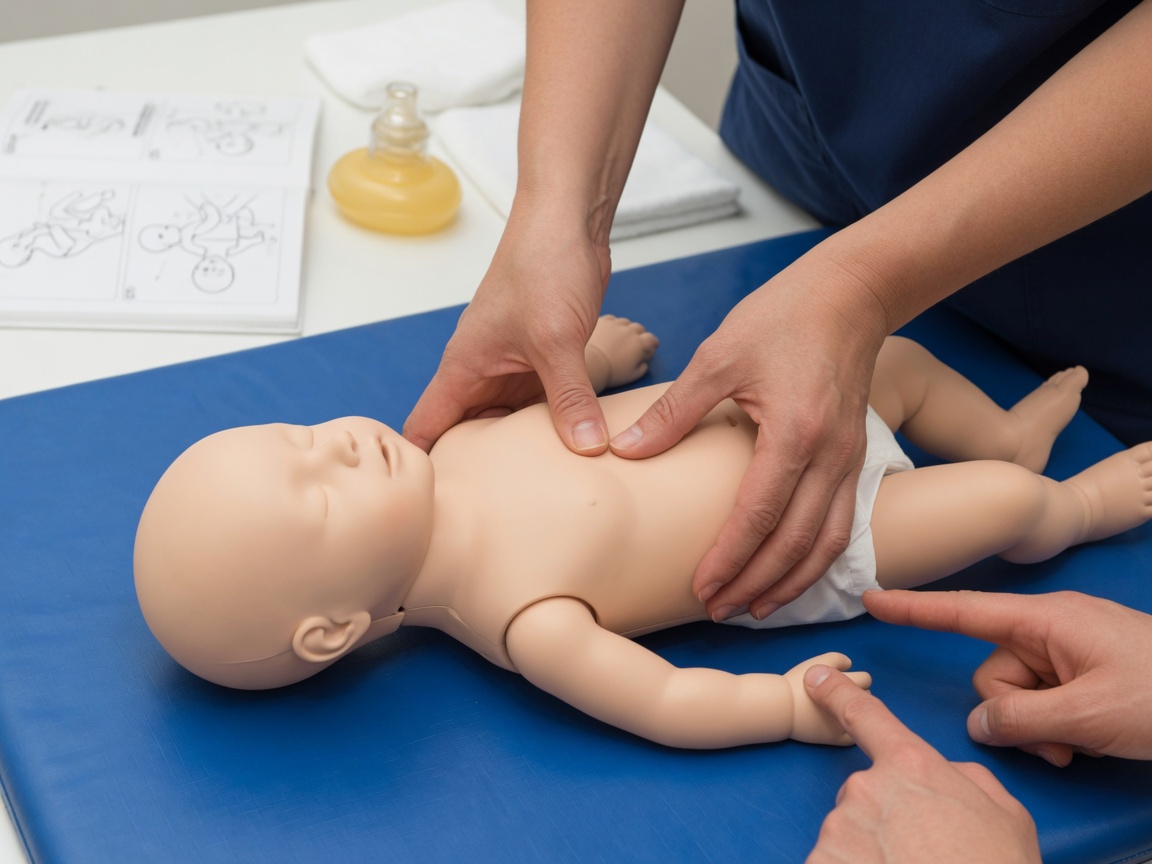
- Infant CPR (Under 1 Year Old): Learning the delicate two-thumb-encircling hands technique, compressing the chest to a depth of approximately 1.5 inches.
- Child CPR (Ages 1 to Puberty): Using a one- or two-handed technique to compress the chest to a depth of approximately 2 inches.
- Rescue Breathing: Understanding the vital importance of oxygenation in pediatric arrests and delivering appropriate breaths.
2. Automated External Defibrillator (AED) Use
- How to properly place AED pads on an infant or child.
- Operating the AED safely and understanding that modern AEDs are designed to guide you step-by-step with clear voice prompts.
3. Choking Relief
- Recognizing the difference between a mild airway obstruction (where the child can cough) and a severe airway obstruction (where they cannot cough effectively).
- Performing back blows and chest thrusts for responsive choking infants.
- Performing back blows and abdominal thrusts for responsive children.
- Performing CPR for an unresponsive choking victim.
4. Pediatric First Aid & Medical Emergencies
A compliant pediatric first aid course should cover the core emergency topics childcare providers are most likely to face in a group care setting, including:
- Emergency Response in Childcare Settings: Accessing EMS, following a first aid action plan, managing the classroom during an emergency, reassuring children and parents, and helping young children understand emergency procedures.
- Assessment and Safety: Patient examination, injury assessment, standard precautions, personal safety, and suspected head or neck injuries.
- First Aid Supplies and Reporting: Assembly and use of first aid kits, appropriate supplies, and injury reporting.
- Breathing and Medical Emergencies: Respiratory distress, inhaled medications, nebulizers, fainting, seizures, diabetic emergencies, and shock management.
- Injuries and Trauma: Bleeding control, wounds, burns, fractures, sprains, strains, dislocations, dental emergencies, eye injuries, head and neck injuries, amputations, avulsions, punctures, and penetrating injuries.
- Environmental and Exposure Emergencies: Environmental exposure, toxic substances, bites and stings from humans, animals, snakes, insects, and marine life.
Frequently Asked Questions About CPR Certification for Childcare
To help you maintain continuous compliance and keep the children in your care safe, we have compiled answers to the most common questions childcare providers ask us.
How often must childcare CPR certifications be renewed?
Pediatric CPR First Aid certifications must be renewed every two years.
It is critical that you do not let your certification lapse. If a Community Care Licensing inspector conducts an on-site visit and finds that your card has expired — even by a single day — your facility will be issued a notice of deficiency.
You will typically have a short window to correct the violation, but repeated or uncorrected training deficiencies can lead to heavy fines, licensing probation, or even the revocation of your childcare license. We recommend setting a calendar reminder three months before your card’s expiration date so you can schedule your renewal class stress-free.
What is the difference between adult and pediatric CPR?
While the basic concept of CPR is the same, the physical techniques for adults and children are very different:
| Feature | Infant CPR (Under 1 Year) | Child CPR (1 to Puberty) | Adult CPR (Puberty & Older) |
|---|---|---|---|
| Hand Placement | 2 thumbs on the center of the chest, with hands encircling the chest when feasible | 1 or 2 hands on the lower half of the breastbone | 2 hands on the center of the chest, on the lower half of the breastbone |
| Compression Depth | About 1.5 inches | About 2 inches | At least 2 inches |
| Compression Rate | 100 to 120 beats per minute | 100 to 120 beats per minute | 100 to 120 beats per minute |
| Rescue Breaths | Cover mouth and nose, deliver gentle puffs of air to achieve chest rise | Pinch nose closed; deliver breath to achieve chest rise | Pinch nose closed; deliver breath to achieve chest rise |
Because children have much smaller, more fragile airways and bones, applying adult-strength compressions to an infant or child can cause severe internal injuries. Conversely, failing to push deep enough on an adult will not circulate enough oxygenated blood to the brain.
To learn more about these critical differences, check out our comprehensive CPR Guide.
Are there training options available for childcare providers?
Yes! If you run a childcare center or have a large team of preschool teachers, keeping track of individual expiration dates can be a logistical headache.
We specialize in group compliance training and private on-site classes. We can bring our professional instructors, high-quality infant and adult manikins, AED trainers, and first aid supplies directly to your school, daycare, or community organization. This allows your entire team to complete their required training together, keeping everyone on the same renewal cycle and saving you time.
Conclusion
Obtaining and maintaining the correct CPR certification for childcare is about much more than checking a box on a state licensing checklist. It is about building a culture of safety, protecting your business, and gaining the ultimate peace of mind that comes from knowing you are prepared to save a child’s life if the unthinkable happens.
At Vive CPR, we are proud to serve as a trusted American Heart Association (AHA) Training Site based in Rohnert Park, California. We provide top-tier, compliant training to individual providers, healthcare professionals, and childcare teams throughout Santa Rosa, Rohnert Park, Sonoma County, Napa, Marin, and the greater San Francisco Bay Area.
Why choose us for your childcare certification?
- First Responder Instructors: Learn from active firefighters, paramedics, and registered nurses who bring real-world emergency experience to every class.
- Same-Day Certification: Successful completion of your course means you will receive your official digital certification card the very same day — no waiting around for shipping.
- Flexible Scheduling: We offer weekday, evening, and weekend classes to fit into your busy schedule.
- Highly Rated: We are known for our engaging, stress-free teaching style, backed by more than 1,000 five-star reviews across Google and Yelp.
Don’t wait until an inspector is at your door or an emergency occurs. Take the proactive step to protect the children in your care today.
Explore our upcoming classes and secure your spot. Have questions or want to book a private group training for your childcare team? Contact us today, and let us help you stay safe, compliant, and prepared!
