

Why AHA Basic Life Support Certification Could Save a Life
AHA Basic Life Support certification is the most widely recognized credential for healthcare professionals who need to respond to cardiac emergencies — and it could be the difference between life and death for a patient in your care.
Here’s what you need to know at a glance:
| Topic | Quick Answer |
|---|---|
| What is AHA BLS? | A training course teaching high-quality CPR, AED use, and emergency response skills |
| Who needs it? | Nurses, EMTs, physicians, dental staff, medical students, and first responders |
| How long is it valid? | 2 years |
| Can I do it fully online? | No — in-person skills validation is required |
| How long does the course take? | About 2.5 to 4.5 hours, depending on course format |
The numbers behind cardiac arrest are stark. Nearly 360,000 out-of-hospital cardiac arrests happen in the United States every year. Only about 10% of those patients survive. And roughly 70% of those emergencies occur at home, not in a hospital.
But here’s the hopeful part: bystander CPR, when performed immediately, can double or triple a victim’s chance of survival. That’s not a small improvement. That’s the difference between a funeral and a recovery.
AHA BLS training exists to close that gap — equipping healthcare providers and first responders with the skills to act fast, act correctly, and act with confidence when every second counts.
Understanding Basic Life Support vs. CPR and First Aid
It is common to hear the terms “CPR,” “First Aid,” and “BLS” thrown around interchangeably, but they represent very different levels of training and clinical responsibility.
- First Aid focuses on immediate, non-invasive care for injuries and illnesses. It covers things like bandaging cuts, splinting sprains, managing burns, and recognizing strokes or heart attacks.
- CPR (Cardiopulmonary Resuscitation) is a specific set of physical actions — chest compressions and rescue breaths — used to keep oxygenated blood flowing to the brain when the heart stops.
- Basic Life Support (BLS) is a comprehensive, higher-level clinical certification. It includes CPR and automated external defibrillator (AED) usage, but elevates these skills for professional healthcare environments.
According to The Ultimate Guide to BLS Certification Classes, BLS training places a heavy emphasis on rapid clinical decision-making, advanced airway management, and highly structured team dynamics. While a standard CPR class might teach a single layperson how to help a neighbor, a BLS course prepares you to step into a chaotic multi-rescuer resuscitation attempt. You will learn how to integrate seamlessly into a team, communicate clearly under pressure, and switch roles efficiently to prevent rescuer fatigue.
Why Healthcare Providers Need AHA Basic Life Support Certification
If you work in a clinical setting, having a standard CPR card usually isn’t enough. Hospitals, outpatient clinics, dental offices, and emergency services require AHA Basic Life Support certification as a condition of employment and licensing compliance.
The American Heart Association (AHA) curriculum is widely considered the gold standard for healthcare providers. Why? Because it is built directly on evidence-based resuscitation science and updated continuously to reflect clinical best practices. Holding an official AHA BLS Provider card proves to employers that you have mastered the precise physical techniques and critical-thinking pathways necessary to save lives in a professional setting. For more information on professional standards, visit the American Heart Association’s Basic Life Support class information page.
Mastering the Core Skills of AHA Basic Life Support
At its heart, BLS is about delivering high-quality cardiopulmonary resuscitation. “High-quality” isn’t just a buzzword; it refers to a specific set of performance metrics that have been proven to maximize a patient’s chances of survival.
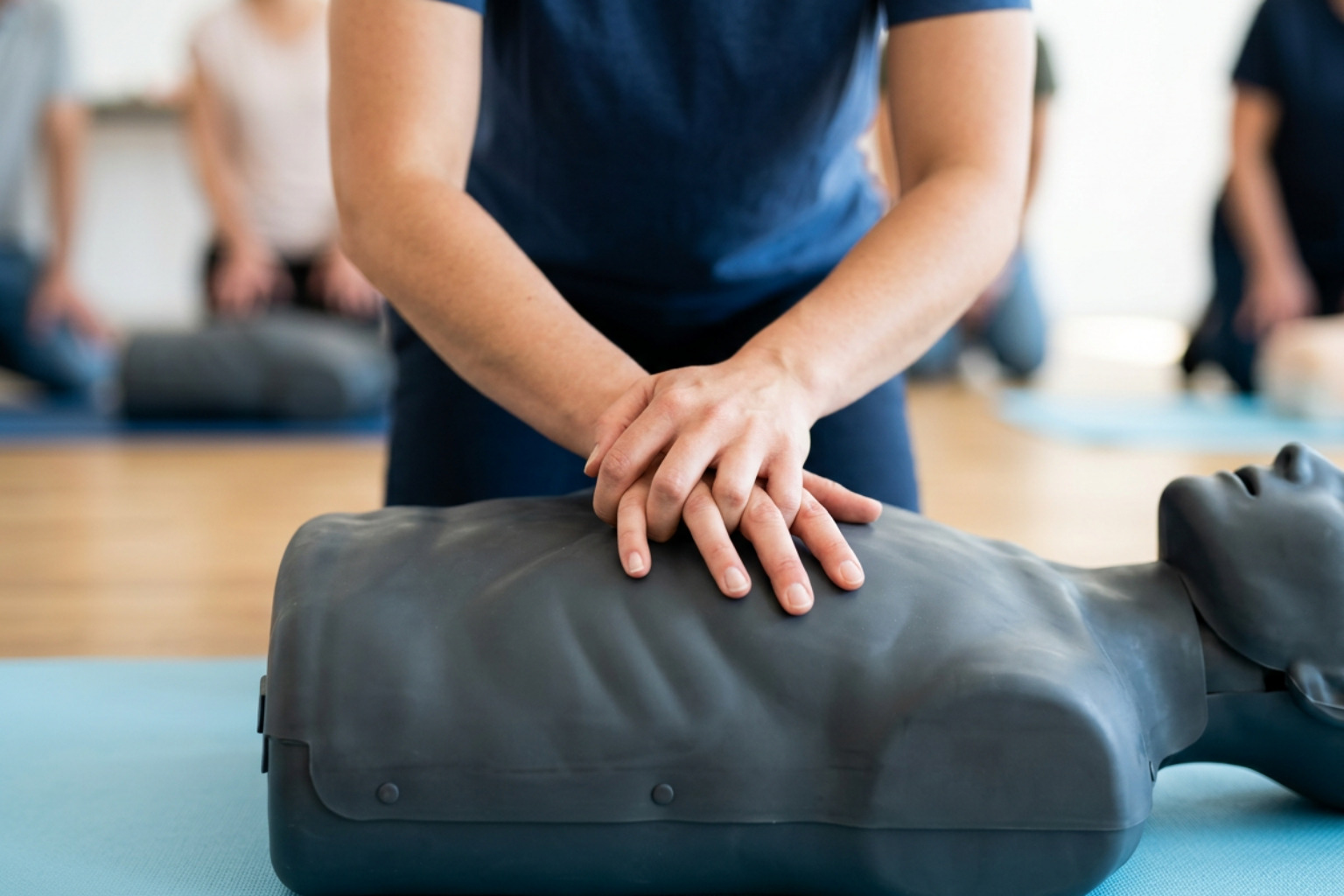
According to the official 2025 BLS Provider Manual, the core components of high-quality CPR include:
- Compression Rate: You must compress the chest at a rate of 100 to 120 compressions per minute. Think of the beat of the song “Stayin’ Alive” or “Another One Bites the Dust” (though we prefer the optimistic energy of the first one!).
- Compression Depth: For adults, compress the chest to a depth of at least 2 inches (5 cm)
- Chest Recoil: Allow the chest to fully recoil after each compression. Leaning on the chest prevents the heart from refilling with blood between compressions, drastically reducing the effectiveness of your efforts.
- Minimize Interruptions: Keep pauses in chest compressions to less than 10 seconds. Every time you stop pushing, the patient’s blood pressure drops to zero, and it takes several compressions to build that vital perfusion pressure back up.
- Effective Breaths: Deliver rescue breaths over 1 second, providing just enough volume to see visible chest rise. Avoid hyperventilation, which can increase pressure inside the chest and decrease blood return to the heart.
Adult, Child, and Infant BLS Protocol Differences
A patient’s age dictates how you perform BLS. Children and infants have different physiological needs than adults, and your resuscitation techniques must adjust accordingly.
To help visualize these changes, refer to the BLS Algorithms or review the key technical differences outlined below:
- Age Definitions: In BLS, an infant is anyone under 1 year of age (excluding newborns). A child is from 1 year of age to puberty (indicated by underarm or chest hair in males, and breast development in females). Anyone past puberty is treated as an adult.
- Pulse Check Locations: For adults and children, check the carotid pulse in the neck. For infants, check the brachial pulse on the inside of the upper arm.
- Compression Techniques: For adults, use a two-handed technique on the lower half of the breastbone. For children, use either a one-handed or two-handed technique depending on the child’s size. For infants, use the two thumb-encircling hands technique.
- Compression Depth: Adults require at least 2 inches (5 cm). Children require about 2 inches (5 cm). Infants require about 1.5 inches (4 cm).
- Compression-to-Ventilation Ratios:
- For adults, the ratio is always 30 compressions to 2 breaths, whether there are one or two rescuers.
- For children and infants, the ratio is 30:2 if you are a lone rescuer. If a second trained rescuer joins, the ratio switches to 15:2 to provide more frequent oxygenation.
The Critical Role of an AED in Resuscitation
An Automated External Defibrillator (AED) is a sophisticated, portable device that can analyze a patient’s heart rhythm and, if necessary, deliver an electrical shock (defibrillation) to help re-establish an effective rhythm.
When sudden cardiac arrest occurs, the heart often enters a chaotic state called ventricular fibrillation (VF) or pulseless ventricular tachycardia (pVT). The heart muscle is quivering rapidly but cannot pump blood. High-quality CPR keeps oxygen flowing to vital organs, but defibrillation is the only way to “reset” the heart’s electrical system.
Using an AED immediately when it becomes available is vital. In fact, rapid defibrillation combined with high-quality CPR can double or triple a patient’s chance of survival.
When using an AED, remember these basic steps:
- Turn the device on immediately and follow the voice prompts.
- Apply the pads to the patient’s bare chest. For adults, place one pad on the upper right chest and the other on the lower left side (lateral to the left nipple).
- If the patient is a child or infant under 8 years of age, use pediatric pads or a pediatric attenuator if available. If not, use adult pads, ensuring they do not touch or overlap.
- Let the AED analyze the rhythm. Ensure nobody is touching the patient during analysis.
- If a shock is advised, loudly clear the patient (“Everyone clear!”) and press the shock button. Immediately resume chest compressions after the shock is delivered.
Understanding AHA BLS Standards and Training Formats
The American Heart Association updates its guidelines regularly to ensure that BLS training reflects the absolute latest in emergency cardiovascular care research. Choosing an AHA-accredited course means you are receiving instruction that meets the rigorous standards required by hospitals, state licensing boards, and emergency services.
Choosing the Right Format for Your AHA Basic Life Support Training
We understand that healthcare professionals have busy schedules. To accommodate different learning preferences, AHA BLS training is offered in two main formats:
- Traditional Classroom Training: This is a fully instructor-led, in-person course. You sit in a classroom, watch instructional videos, practice hands-on skills with real-time feedback from an instructor, and take your written exam and skills test all in one session. This format typically takes about 3 to 4.5 hours.
- Blended Learning (HeartCode BLS): This format splits the course into two parts. First, you purchase and complete the self-paced online portion, known as the AHA HeartCode BLS Online Course. This online module uses interactive simulations and cognitive assessments to teach the material. Once you pass the online portion, you print your completion certificate and attend an in-person, Skills Session to practice and verify your physical techniques. The Skills Session can be led by an instructor (“Instructor-Led Skills Session”), or by a computer (“Voice Assisted Manikin Skills Session”). At Vive CPR, our Skills Sessions are always led by experienced instructors. To get started with this flexible option, you can enroll in our Blended Learning BLS class.
Advanced BLS Scenarios: Chains of Survival, Opioids, and Choking
Resuscitation does not occur in a vacuum. A patient’s environment dictates how emergency care is structured. The AHA visualizes this journey through the Chains of Survival, which differ slightly depending on whether the cardiac arrest occurs inside a hospital or out in the community.
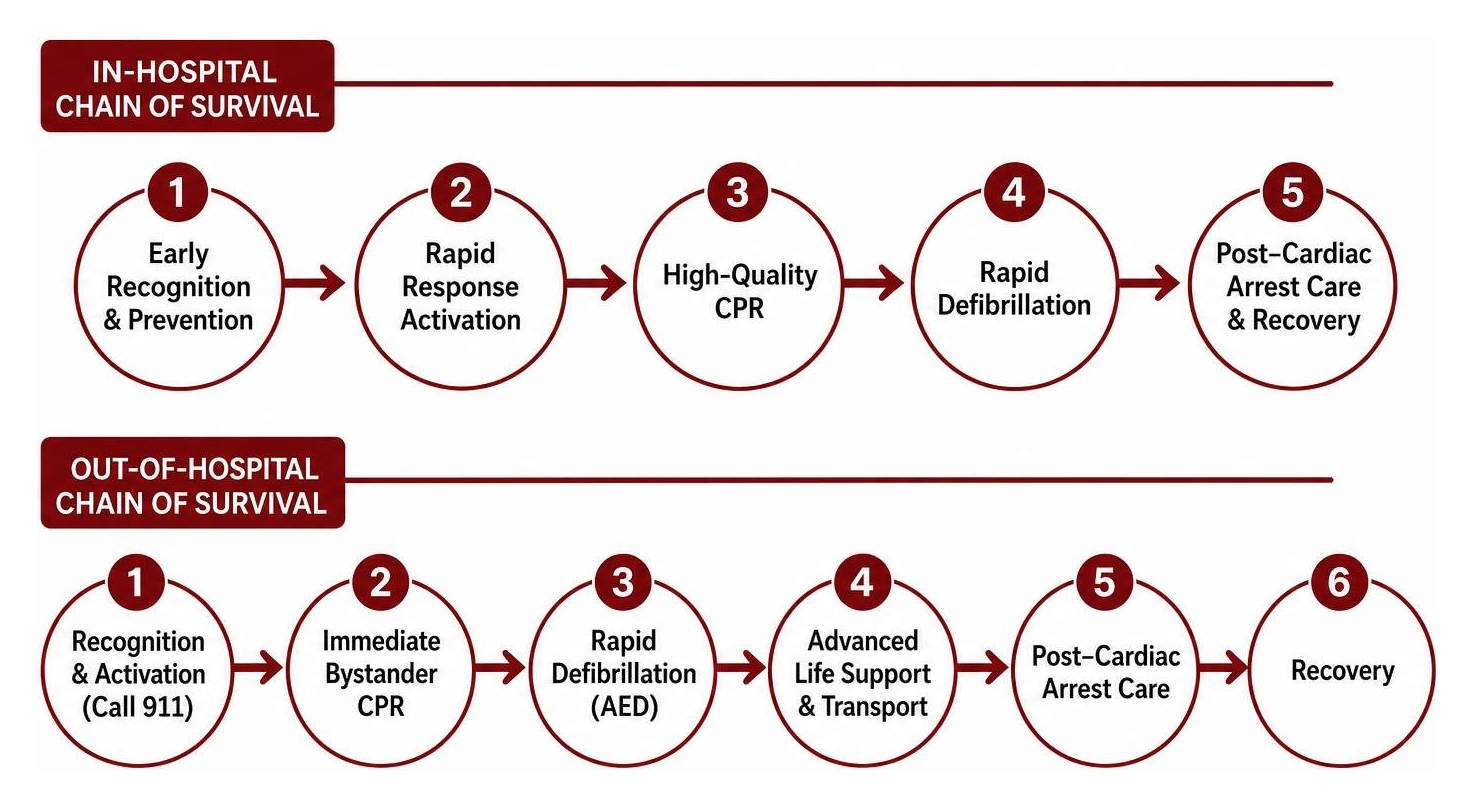
The links in these chains represent the critical steps needed to save a life:
- In-Hospital Cardiac Arrest (IHCA): Focuses heavily on early surveillance, prevention, and rapid response team activation within a medical facility, followed by high-quality CPR, rapid defibrillation, post-cardiac arrest care, and recovery.
- Out-of-Hospital Cardiac Arrest (OHCA): Begins with immediate recognition of cardiac arrest and activation of the emergency response system (calling 911), followed by rapid bystander CPR, quick defibrillation with a public AED, advanced life support transport, post-cardiac arrest care, and long-term recovery.
For a deeper dive into these scientific updates, read the American Heart Association 2025 Guidelines for Cardiopulmonary Resuscitation and Emergency Cardiovascular Care.
Opioid-Associated Emergencies and Naloxone Administration
The ongoing opioid crisis has made opioid overdose recognition a standard component of modern BLS training.
If you suspect an unconscious patient is experiencing an opioid-associated emergency, look for the “opioid triad” of symptoms:
- Extreme sleepiness or unresponsiveness
- Slow, shallow, or absent breathing (respiratory depression)
- Pinpoint pupils
If the patient has a pulse but is not breathing normally (respiratory arrest), provide rescue breaths (1 breath every 6 seconds for an adult) and administer naloxone (Narcan) if it is available. Naloxone is a safe, highly effective medication that reverses the effects of an opioid overdose. If the patient has no pulse and is not breathing, immediately start high-quality CPR and administer naloxone while waiting for the AED to arrive.
Foreign-Body Airway Obstruction and Choking Relief
When a foreign object blocks a person’s airway, quick intervention is required to prevent cardiac arrest.
- Conscious Adults and Children: Stand behind the patient, wrap your arms around their waist, make a fist with one hand, place it just above the navel, and deliver quick, upward abdominal thrusts until the object is expelled or the patient becomes unresponsive.
- Conscious Infants: Sit down, rest the infant face-down along your forearm, support their head and jaw, and deliver up to 5 sharp back blows between the shoulder blades. If the object isn’t freed, flip the infant face-up, supporting the back of their head, and deliver up to 5 quick chest thrusts. Repeat this cycle of 5 back blows and 5 chest thrusts until the object is expelled or the infant becomes unresponsive.
- Unresponsive Choking Patients (All Ages): If a choking patient becomes unresponsive, carefully lower them to the ground and immediately begin chest compressions. Do not check for a pulse. Each time you open the airway to give rescue breaths, look inside the mouth. If you see the foreign object, carefully remove it with your fingers. If you don’t see anything, do not perform a blind finger sweep, as this can push the object deeper into the airway.
Frequently Asked Questions about BLS Certification
How long is my BLS certification valid?
Your official AHA BLS Provider certification is valid for two years through the end of the month. To maintain clinical compliance for your job or school program, you must complete a BLS renewal course before your current card expires.
Can I complete my BLS certification entirely online?
No. The American Heart Association does not issue official BLS Provider cards for 100% online courses. While you can complete your cognitive learning online through a Blended Learning format like the AHA HeartCode BLS Online Course, you must always complete an in-person, hands-on Skills Session with a certified instructor to verify your physical compression and ventilation techniques.
What is the difference between BLS and ACLS?
While BLS covers the essential hands-on skills of resuscitation, such as CPR, AED use, and ventilation, Advanced Cardiovascular Life Support (ACLS) is a higher-level course for advanced medical providers. ACLS builds on BLS with advanced airway management, cardiac rhythm interpretation, medication use, and structured team leadership during complex cardiac arrest and cardiovascular emergencies.
ACLS is typically needed by healthcare professionals who direct or participate in advanced emergency care. This often includes physicians, nurses, paramedics, respiratory therapists, emergency department staff, ICU and critical care teams, anesthesia providers, and other clinicians whose job may involve managing cardiac arrest, stroke, acute coronary syndromes, or unstable heart rhythms.
Conclusion
Obtaining your AHA Basic Life Support certification is more than just checking a box for work compliance; it is a commitment to being prepared when a life-or-death emergency occurs.
If you are ready to earn or renew your certification, we are here to help. Vive CPR is an official American Heart Association (AHA) Training Site based in Rohnert Park, California, serving Santa Rosa, Rohnert Park, Sonoma County, Napa, Marin, and the greater San Francisco Bay Area.
Our classes are taught by professional first responders and healthcare professionals — such as firefighters, paramedics, and registered nurses — who bring real-world lifesaving experience to the classroom. We offer flexible scheduling, including weekday, evening, and weekend options, with same-day certification issuance upon successful completion.
To ensure you receive the highest quality of instruction, all of our Skills Sessions are completed in person with a live instructor; we do not use Resuscitation Quality Improvement (RQI) or Voice-Assisted Manikin (VAM) training.
Ready to get certified? Visit us to explore our Instructor-Led BLS or Blended Learning BLS course options, and enroll in a class today.
