

Why CPR Training in Petaluma Could Save a Life
CPR classes in Petaluma range from AHA-certified BLS courses for healthcare professionals to Heartsaver CPR First Aid classes for teachers, parents, and workplace teams.
Here’s a quick overview of what’s available:
| Course Type | Who It’s For |
|---|---|
| Heartsaver CPR AED | General public, community organizations, teachers, coaches, trainers, office staff, construction workers, industrial workers |
| Heartsaver First Aid CPR AED | General public, community organizations, teachers, coaches, trainers, office staff, construction workers, industrial workers |
| Heartsaver Pediatric First Aid CPR AED | Licensed childcare providers, daycare workers, preschool workers |
| BLS (Basic Life Support) | Physicians, dentists, nurses, EMTs, paramedics, respiratory therapists, physical therapists, occupational therapists, physician assistants (PAs), dental assistants, medical students, nursing students, residents, fellows, medical trainees, aides, medical assistants, nursing assistants, police officers, security officers, and other medical staff |
| ACLS (Advanced Cardiovascular Life Support) | Physicians, nurses, paramedics, physician assistants, pharmacists, respiratory therapists, radiology technicians, and others who direct or participate in the management of cardiopulmonary arrest or other cardiovascular emergencies and cardiopulmonary arrest |
| PALS (Pediatric Advanced Life Support) | Physicians, nurses, nurse practitioners, paramedics, physician assistants, pharmacists, respiratory therapists, and others who direct or participate in the management of respiratory and/or cardiovascular emergencies and cardiopulmonary arrest in pediatric patients |
All certifications are valid for two years and must include hands-on skills testing to be accepted by most California employers and licensing boards.
Why does this matter? According to the American Heart Association, without bystander CPR, survival rates for sudden cardiac arrest drop below 5%. With CPR and a defibrillator, that number can climb to nearly 70%. Most cardiac arrests happen outside hospitals — at home, at work, or in public spaces — where trained bystanders are the first line of response.
Whether you’re renewing a healthcare credential, meeting a childcare licensing requirement, or simply want to be prepared for an emergency, getting certified is one of the most practical decisions you can make.
Your Guide to CPR classes in Petaluma and Sonoma County
When searching for the right training program, it is easy to get overwhelmed by the alphabet soup of providers and course names. In Petaluma and the surrounding Sonoma County region, the most widely accepted and requested certifications are those authorized by the American Heart Association (AHA) and the American Red Cross.
These organizations set the gold standard for life-saving protocols. If you are a healthcare professional working at Petaluma Valley Hospital or preparing for clinical rotations at Santa Rosa Junior College, employers will almost universally require official AHA certification. For non-clinical workers, school staff, and childcare providers, Red Cross or AHA certifications are both highly respected and fully compliant with California’s strict workplace safety standards.
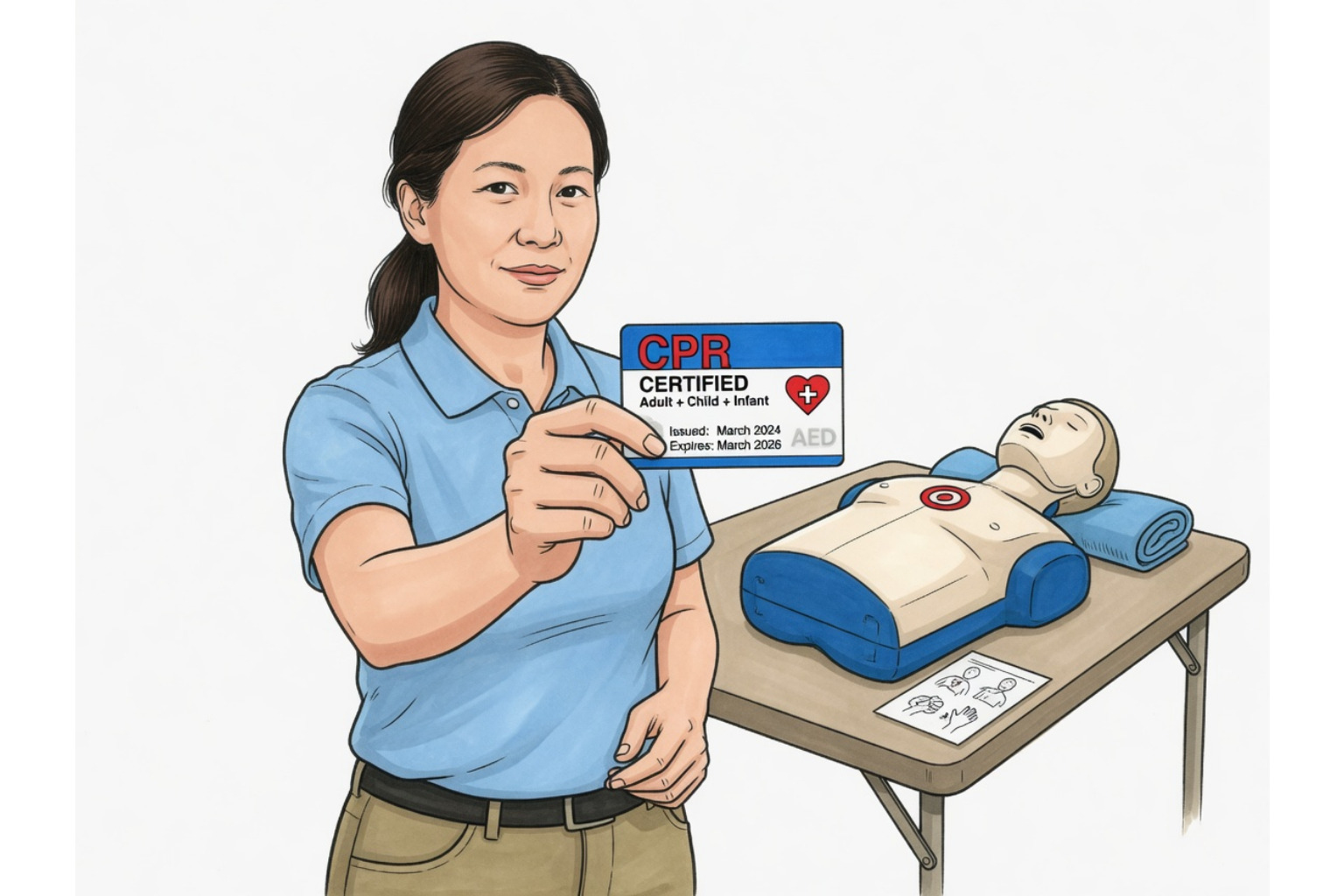
At Vive CPR, we are proud to be an AHA Training Site. While our physical classroom is located just up Highway 101 in Rohnert Park, CA, we regularly serve the entire Petaluma community, including Midtown, East Petaluma, and the surrounding areas of Cotati, Penngrove, and Novato.
We offer OSHA-compliant courses and follow the latest AHA guidelines. When you complete your CPR training with us, you receive an official AHA certification card valid for two years.
If you are looking for local classes, you can learn more through our local guide to AHA CPR in Sonoma County. There are also various local community initiatives, commercial providers, and municipal programs throughout the region that offer training.
Ready to secure your spot in an upcoming session? You can easily enroll in CPR certification today through our simple online registration system.
Key Differences Between BLS and Heartsaver CPR Courses
Choosing the wrong class is one of the most common mistakes people make when registering for CPR classes in Petaluma. Taking a course that does not meet your employer’s specific guidelines can result in wasted time and money.
To help you choose the right path, we have broken down the primary differences between Basic Life Support (BLS) and Heartsaver courses:
| Feature | BLS (Basic Life Support) | Heartsaver CPR AED |
|---|---|---|
| Primary Audience | Healthcare professionals (nurses, EMTs, dentists, doctors, clinical students) | General public, teachers, corporate teams, construction workers |
| Focus Area | Multi-rescuer team dynamics, advanced airways, bag-valve-mask (BVM) ventilation | Single-rescuer CPR, AED operation, basic choking relief for all ages |
| Class Length (Instructor-Led Format) | \~ 3 hours | \~ 2.5 hours |
| Written Exam | Required | Optional (unless required by employer) |
Whether you need a specialized healthcare credential or a general emergency response class, we offer comprehensive options, including our highly rated CPR First Aid certification course. If you have a hectic schedule, you can also explore flexible first aid class options to find a class format that works best for you.
BLS for Healthcare Professionals
The Basic Life Support (BLS) Provider course is specifically designed for individuals who work in a clinical environment or have a professional duty to respond to medical emergencies. This includes nurses, medical assistants, emergency medical technicians (EMTs), paramedics, dentists, and physical therapists.
Unlike basic public courses, BLS focuses heavily on high-performance team dynamics. In a hospital or clinic setting, resuscitation is rarely a solo effort. BLS training teaches you how to step into a multi-rescuer environment seamlessly, coordinate chest compressions, operate a bag-valve-mask (BVM) ventilator, and manage advanced airways.
The pace is fast, the standards are high, and the focus is on keeping chest compressions going with as few interruptions as possible. If you are entering the medical field or need to renew your clinical credentials, you can enroll in a BLS class today.
Heartsaver CPR classes in Petaluma for the General Public
If you do not work in a hospital or dental clinic, the Heartsaver track is likely what you need. These courses are tailored for everyday heroes such as teachers, coaches, fitness instructors, construction workers, industrial workers, office workers, community organization, and parents.
The curriculum focuses on the essential skills needed to keep someone alive until professional first responders arrive on the scene. You will learn how to recognize cardiac arrest, perform high-quality chest compressions, use an Automated External Defibrillator (AED), and help a choking victim.
For those working in licensed California daycare centers or preschools, we offer specialized Pediatric Heartsaver courses that meet the strict guidelines of the Emergency Medical Services Authority (EMSA). Businesses looking to keep their staff prepared can learn more about setting up tailored workplace CPR training programs.
Hands-On Skills Taught in Petaluma CPR Training
Many people assume they can learn CPR just by watching a video online. However, muscle memory is a vital part of emergency response. When adrenaline spikes during a real emergency, your brain relies on physical habits built during hands-on practice.
That is why we do not offer online-only or voice-assisted manikin (VAM) training. Every single certification class we teach includes an instructor-led, hands-on component using high-quality equipment and supplies.
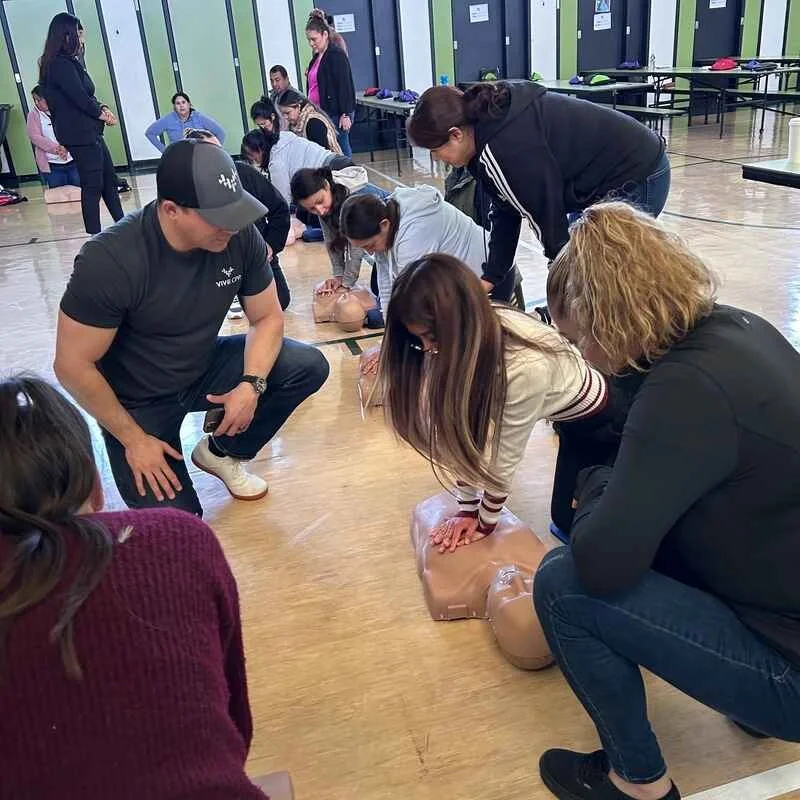
As part of the hands-on practice for BLS or CPR, you will master several critical techniques:
- High-Quality Chest Compressions: Learning the correct depth (2 to 2.4 inches for adults) and rate (100 to 120 compressions per minute) is harder than it looks. We help you find the correct rhythm, which happens to be the beat of the classic song “Stayin’ Alive.”
- AED Operation: Automated External Defibrillators are incredibly safe and easy to use, but practicing with a trainer unit helps remove the fear of using one in real life. You will learn how to turn the device on (the most important step!), correctly apply the pads, clear the patient, and deliver a shock safely.
- Rescue Breathing: We teach proper barrier-device and breathing techniques to deliver life-saving oxygen without putting yourself at risk.
- Choking Relief: You will practice the Heimlich maneuver for adults and children, as well as back blows and chest thrusts for infants.
- Pediatric and Infant CPR: Babies are not just miniature adults. You will practice specialized two-thumb techniques on infant-sized manikins.
If you want to brush up on your knowledge before class, check out our guide on high quality CPR or read our article on what is CPR and why do we do it.
Group and Onsite CPR Training for Petaluma Businesses
If you run a business, school, or medical practice in Petaluma, coordinate training for your team can be a logistical headache. Sending employees to individual classes on their days off is expensive and difficult to track.
We solve this problem by bringing the classroom directly to you. Our mobile, onsite CPR training services allow your team to train together at your actual workplace. This is highly effective because it allows your staff to practice emergency response in the exact environment where an emergency is most likely to occur.
Whether you operate a dental clinic near Petaluma Boulevard, a preschool in East Petaluma, or an industrial facility near Lakeville Highway, our professional instructors (who are active-duty first responders, EMTs, and paramedics) will bring all the necessary equipment directly to your facility.
We offer customized scheduling, including early mornings, evenings, and weekends, to ensure your operations are not disrupted. If you have unique training needs, we can also design a custom CPR class tailored specifically for your organization.
Frequently Asked Questions About Petaluma CPR classes
How long does a CPR certification last?
An official AHA or Red Cross CPR certification is valid for two years. Your certification expires at the end of the month at the two-year mark. To stay current, complete a recertification or renewal course before that expiration date.
We recommend planning your renewal class at least a month before your expiration date as it can be challenging to find a class at the last minute that fits your schedule. To book a local session, visit our enrollment page, or use the American Heart Association’s AHA Class Finder to search for nearby classes.
Is a Heartsaver CPR AED class appropriate for healthcare providers?
No. A Heartsaver CPR AED class is usually not the right choice for healthcare providers who need CPR certification for their job or other regulatory or licensing requirements. Most healthcare employers require BLS certification, because BLS covers more advanced skills like team-based resuscitation, high-quality CPR for adults, children, and infants, bag-mask ventilation, and professional rescuer responsibilities.
Heartsaver CPR AED is better suited for the general public, trainers, workplace responders, teachers, coaches, construction workers, office workers, and industrial workers.
Can I complete my CPR training online?
You can complete the cognitive portion of your training online, but you cannot get a fully compliant, OSHA-approved certification without an in-person, hands-on skills session.
The highly popular “Blended Learning” CPR class format allows you to complete the interactive online modules at your own pace from home, and then complete a short hands-on skills check in person.
To explore this option, check out our Blended Learning CPR certification or our Blended Learning CPR First Aid certification courses.
Do you offer same-day or walk-in classes?
Please note that we recommend registering online in advance for CPR classes, since our classes are limited in size to maintain an appropriate student-to-instructor ratio, and often fill up.
That said, if you need training right away, we may be able to accommodate same-day students when seats are available in a scheduled classroom course. We may also be able to arrange private training to meet your timeline or specific certification needs.
Conclusion
When it comes to emergency preparedness, having high-quality instruction makes all the difference. At Vive CPR, our training is led by professional first responders, EMTs, and paramedics who bring real-world emergency experience directly to the classroom.
Whether you join us at our comfortable Rohnert Park classroom or schedule an onsite group session for your Petaluma business, you will receive engaging, practical instruction that builds real confidence. Our 5-star reputation across Sonoma County reflects our commitment to quality training.
Ready to take the next step? Enroll in one of our CPR classes today to learn valuable lifesaving skills. You can also explore our library of educational resources to keep your life-saving skills sharp.
